by Vishesh Singh, Educator
“Boys are a different breed!”
“He’s such a boy!”
“He’s not really a boy.”
These are phrases we toss around so casually, assuming we know what it means to be a boy—especially based on how they act, talk, dress, or perform masculinity.
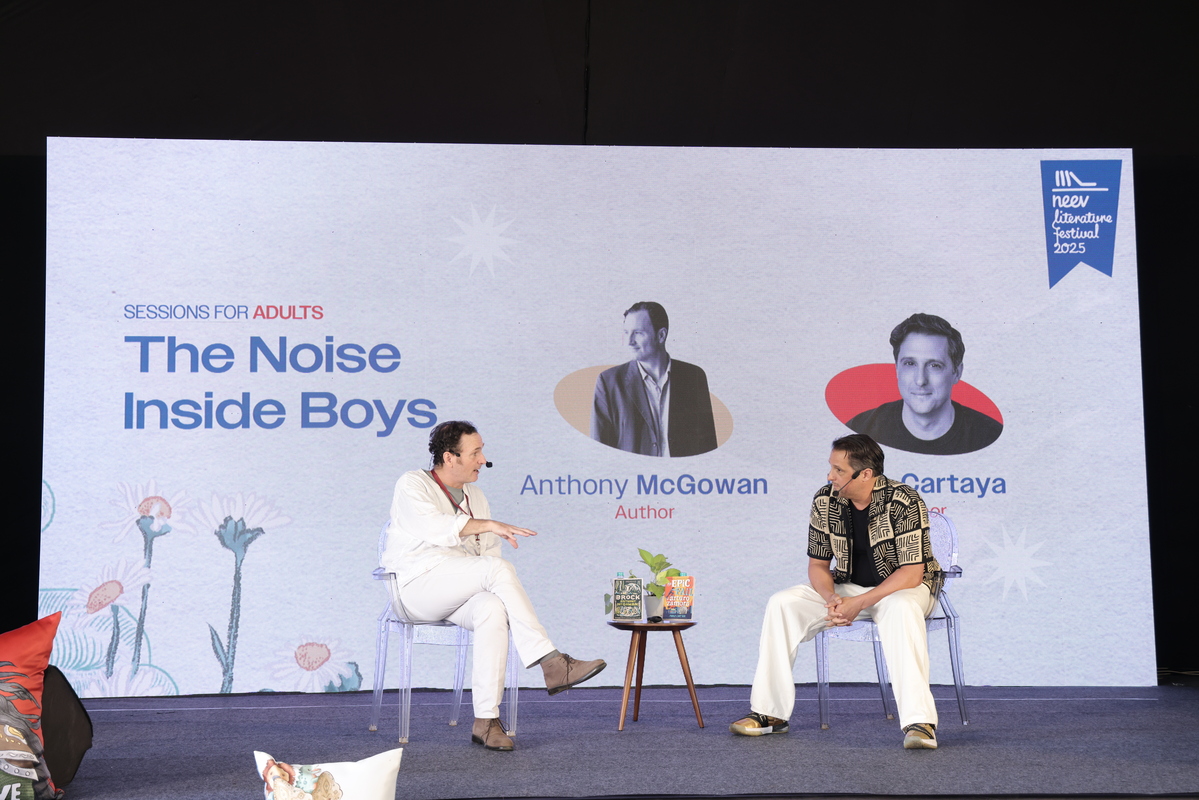
After attending Pablo Cartaya and Anthony McGowan’s session ‘The Noise Inside Boys,’ I find myself still carrying their question: What does it mean to be a boy?
Of course, boys are complex. They are not a monolith. And yet, we often box them into stereotypes that are tough-to-crack shells of expectations, wrapped around tenderness we fail to notice.
As a teacher, I’ve seen the most endearing ways boys express their affection. My boys sneak across the sandpit, squatting low to the ground, only to jump out and try to scare me. Others confide after class with startling honesty: “I know things I shouldn’t be knowing.”
Boys have a special place in my heart. Not because I’m biased, or because girls don’t matter; of course they do, but because boys are often misunderstood. We tend to socialise them too quickly into roles of toughness, of suppression, of doing rather than feeling. And in that rush, we miss the subtle ways they say “I love you.”
We do weird things, we boys. And I’m not talking about the clichés.
As an uncle to a two-year-old nephew, a teacher to ten-year-olds, a 28-year-old man today, and even as I think back to my six-year-old self I keep coming back to the same questions:
Who decided what boys are supposed to be?
How often do we truly listen to the noise inside them?
Do we notice their small gestures as acts of care (offering a lollipop, refilling my water bottle, asking for a fist bump)?
Do we validate them when they say, “I’m not sporty, but I’m okay with who I am”?
We often reduce boys to the role of future breadwinners or protectors, missing the complexity of care, creativity, and vulnerability they carry. Building meaningful relationships with boys requires us to see them for more than their expected roles.
In today’s world of shifting gender identities, of fluidity and redefinition, what does it mean to be a boy in the time of the non-binary? How do technology, social media, and societal expectations shape this identity? Do these prompt our boys to ‘locker room’ cases? Or not? I am not sure.
More importantly, how often do we allow ourselves as boys, men, uncles, brothers, teachers to be vulnerable? To love loudly? To not feel ashamed for caring deeply?
This talk reminded me that we must hold space for the many versions of boys we meet; whether they’re loud, quiet, goofy, angry, sensitive, or unsure.
Helping boys live authentic lives means showing up for the silly check-ins, the random conversations, the unexpected hugs. It means offering them a world where they don’t have to carry it all alone.
Maybe the first step is for me to loosen the grip on who I think I need to be—and simply be there for the boys in my life.
Maybe that’s how we start healing.
Maybe that’s how they start believing.
Boys are a different breed.
And they love deeply.
So let’s listen—because the noise inside them deserves to be heard.