by Adarshini Chandrakanth, Grade 11
Currently, studies in archeology are as close as we can get to a time machine, the only scientific discipline that can whiz us back to the past. Prolific science writer Sam Kean agrees… but also disagrees. To set the stage, Mr. Kean candidly expressed his opinion that archeologists are the guiding lights in materializing our curiosities about past civilizations, but he found his shoulders droop when witnessing them work. To him, the act of dusting off broken shards of pots with toothbrush-like tools under the scorching sun is rather dull and lacklustre. That’s when he was introduced to the idea of experimental archeology, an eccentric and niche field in which scientists and other experts try their hands at ancient practices, simulating their theories to derive conclusions. Through his book interaction session, author Sam Kean took us through the extraordinary experiences he had when establishing the groundwork for his new book, Dinner with King Tut: How Rogue Archaeologists Are Re-creating the Sights, Sounds, Smells, and Tastes of Lost Civilizations.
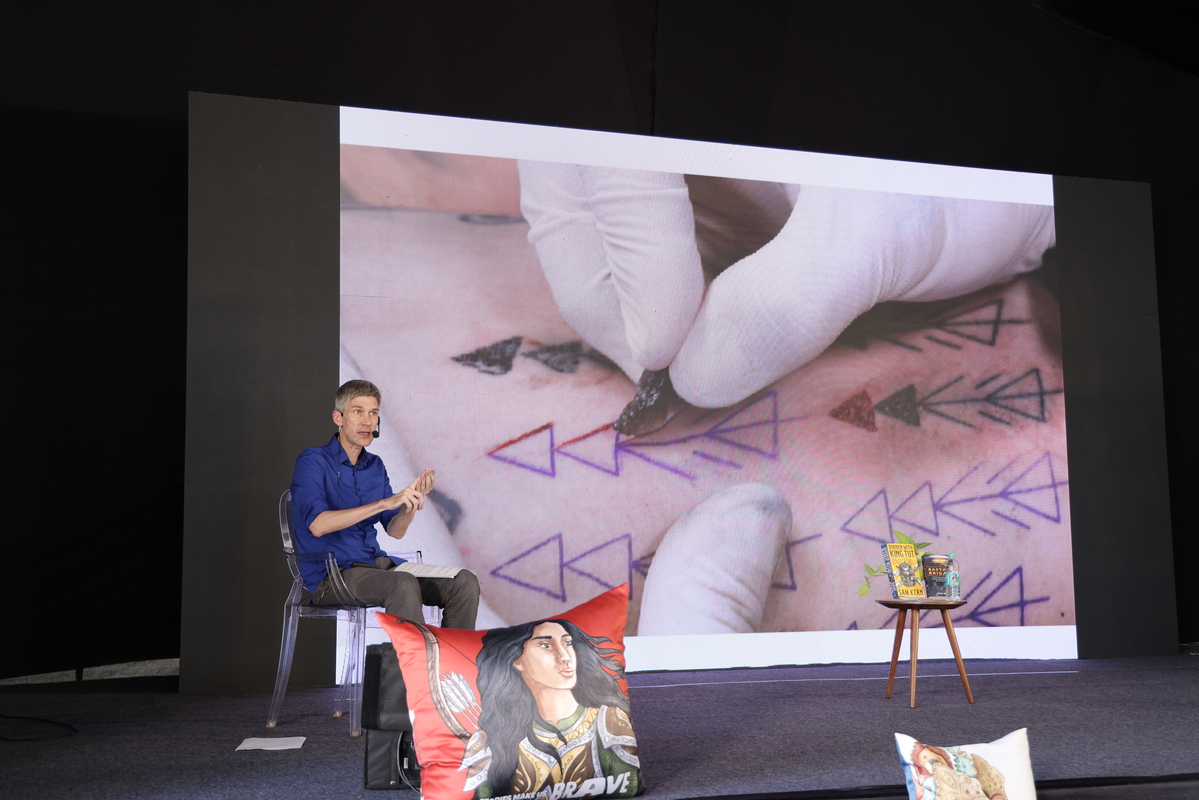
Mr. Kean commenced with the familiar topic of mummies, but with a tale about tattoos. The discovery of Ötzi, with a surprising number of over 60 tattoos on his well-preserved body, was an instance in which experimental archaeology played out. Questions surrounding how ancient Egyptians made permanent body art led to a tattoo specialist testing obsidian tools and bone needles on himself! Mr. Kean added that he himself got a tattoo with the authentic bone-needle. He even inked one on his tattoo artist, only to learn that the artist already had many similar tattoos as he’d lent his body to the North Atlantic tribal women who attempted to re-learn their lost inking tradition. Mr. Kean expressed through this interaction, that the collective passion to excavate the past is led by indigenous communities, who are trying to prevent their cultures from dwindling away.
On a humorous note, Mr. Kean transported us to the world of the ancient Mexicans. He shared a hilarious memory where he played an ancient Mesoamerican ballgame that was used as a military strengthening exercise by the Aztecs; one that left him “wincing at the sight of stairs” the next day. Despite always being up for a sportive challenge, Mr. Kean recollected that this game was one “that left him hiding behind a 12 year old” as he was terrible at it, generating a wave of chuckles amongst the audience. His takeaway from the experience was that a “good way to learn is by being bad at something” and that “emotions of frustration are important to the learning process”, something that resonated with us as it reinforced the importance of resilience. He also narrated to us other fun stories, such as building a 30 foot tall catapult and hurling metal weights from it, in the name of reconstructional archaeology, of course.

Next, he showed us how this field has counterintuitively propelled scientific endeavors in the present. He expressed this through the case of a peculiar recipe in a leech book (medieval doctor’s guide) becoming the solution for a modern medicine crisis. According to a leech book, a stye could be resolved with a strange concoction of onion, garlic, wine and ox bile, stored in a copper bowl. A solution that appears bloody gray with the use of red wine and alarmingly radioactive green with white wine, has been investigated by a microbiologist and historian, in resolving… antimicrobial resistance. Apparently, this mixture tears apart biofilms that bacteria create as a physical defense mechanism that would otherwise make them impenetrable. This has been proven useful in resolving bacterial infections of Staphylococcus aureus, one that is notoriously undefeated by drugs. This narration had some of the audience gasping and disbanded my prior notions that all naturopathic solutions are ineffective.
This session thoroughly captivated a rare mix of middle-school students, adults and fellow experts all alike, as seen in its Q&A. Audience members asked Mr. Kean thoughtful questions, such as what he would like to leave behind for future archeologists. To this, he answered that leaving our footprints through writing on stone will be the most effective way of capturing our present. He was also asked how the biases of glorifying the past versus the present in eastern and western literature respectively impact archeologists’ studies, to which he expressed a nuanced opinion. Despite it being a “common failing” as it’s “hard to take the blinders off”, like any other scientific discipline, personal biases shouldn’t be muddled with work. He was also asked about novel technology that is enhancing progress in the field, to which he revealed the strides in DNA and chemical analysis, isotope tracing and LIDARs, and how they play a pivotal role in discovering lost civilizations. In an interaction with archeologist and author, Devika Cariapa, he briefly discussed archeology’s prior reputation of being a “fringe discipline”, it evolving to be collaborative, and recreation as a research method growing more promising by the day.
Through his fascinating storytelling, Mr. Kean left the audience with a few pearls of wisdom. He expressed that recreational archeology is an emerging field that relies on experts reliving history to decipher it with all senses. It is an immersive interdisciplinary subject that doesn’t require “an archeology degree”, is one that holds value for our present and future, and is one filled to the brim with learning. He also signaled that one’s mental stamina is built when they overcome challenges, and it is not only natural, but imperative in building a learner. Overall, the award-winning writer and narrator left an already scientifically enthusiastic audience, including a few who were previously repelled by archaeology, even more curious to learn about the bizarre ways of recreational archeology through his latest book.